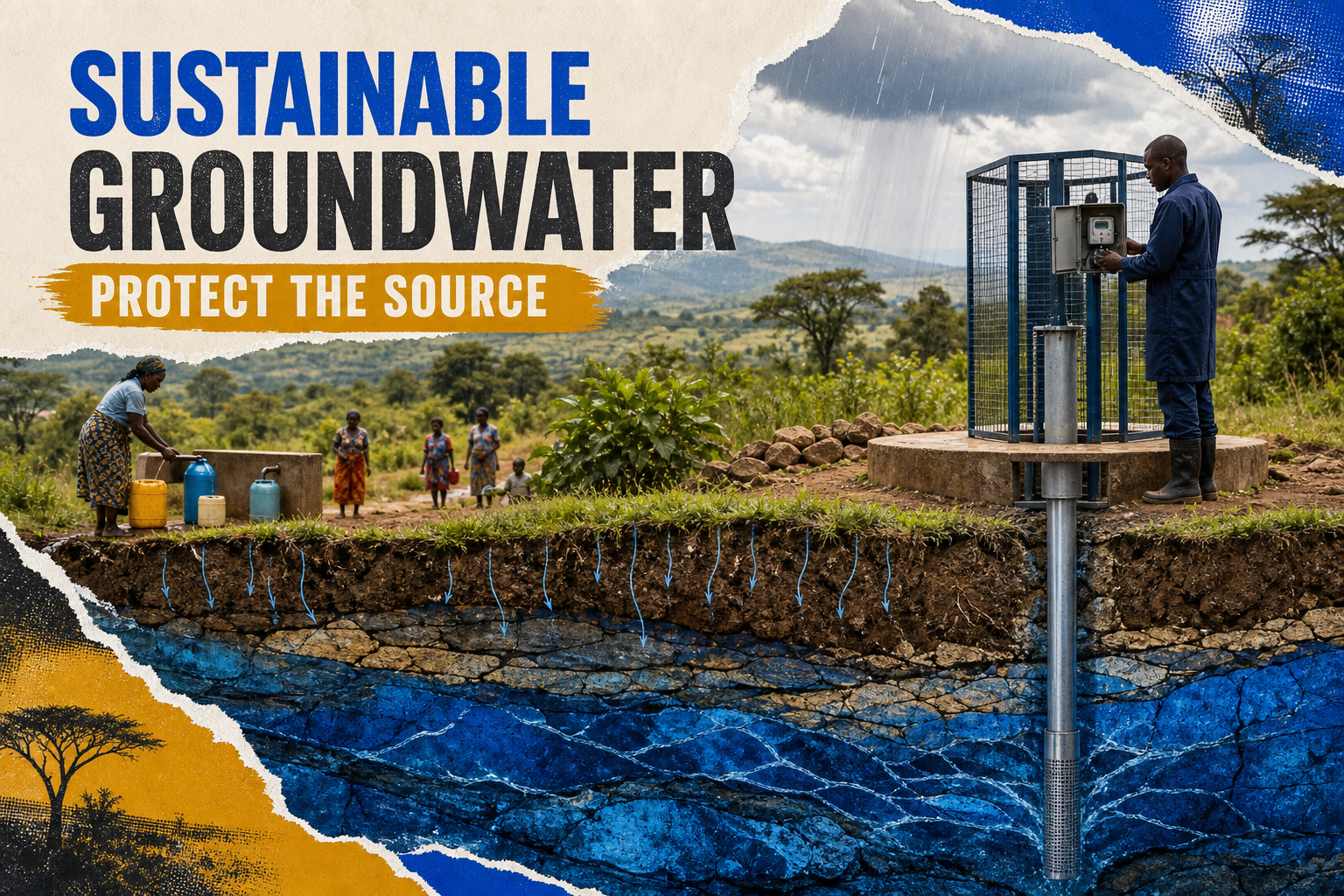
Start with the decision, not the equipment
sustainable groundwater Kenya is best understood through the decision it must support: How can a productive borehole remain dependable without damaging water quality or the aquifer? For individual boreholes, shared supplies, farms and growing developments, the answer is site-specific. Geology, demand, regulation, access and the intended use of the water interact. A useful plan therefore begins with evidence and records its assumptions instead of promising a standard result.
The core scope normally covers safe yield, monitoring, metering, sanitary protection, recharge areas, pollution prevention, demand management and governance. Leaving one of those stages undefined can shift cost or risk downstream. Our borehole services connect the stages, while the project process shows the acceptance point between them.
What the search term does—and does not—tell you
People searching for sustainable groundwater Kenya often want a single number or yes/no answer. Search results can provide orientation, but they cannot see the site, confirm the aquifer, measure demand or determine the applicable permit category. Published averages should be treated as planning context, not a quotation or hydrogeological conclusion.
The main avoidable error is equating a strong short pump test with unlimited water or ignoring nearby contamination pathways. A better outcome is an operating plan that protects the source, users and surrounding groundwater resource. That requires a written basis: source data, field observations, calculations, exclusions and the person responsible for confirming each critical input.
The evidence to collect before work starts
Gather the site coordinates, ownership or authority to use the land, access constraints, nearby borehole information if legitimately available, expected daily and peak demand, intended water uses, power options and storage requirements. Note potential contamination hazards such as sanitation systems, waste areas, fuel, livestock concentration or industrial activity.
Existing records are useful when their origin and date are known. A neighbour's reported depth may help a hydrogeologist form a regional picture, but it is not a substitute for project-specific assessment. Groundwater occurs within geological structures that can change over short distances.
Surveying and siting
A hydrogeological investigation combines available maps and records with field reconnaissance and, commonly, geophysical measurements. The aim is to identify a target consistent with the local geological model while considering access, drainage, contamination setbacks and construction practicality. It reduces uncertainty; it does not remove it.
Kenya's Water Resources Authority says its groundwater codes cover borehole siting, construction, supervision and pumping tests. Following those professional stages helps reduce failure risk and supports sustainable investment. Read our detailed hydrogeological survey guide before selecting a drilling point.
Regulatory planning in Kenya
Groundwater is a regulated water resource. The applicable steps depend on the proposed use and permit category, so a project team should verify current requirements directly with the Water Resources Authority and relevant county or service institutions before physical work. Forms, charges and timelines can change; archived checklists should not be treated as current approval.
The 2021 Water Resources Regulations contain provisions for authorisation or permits for drilling and for groundwater protection. WRA's service charter lists services and category-based fees. Our permit guide explains the sequence, but it is practical information rather than legal advice.
Construction quality below ground
Once authorised and mobilised, drilling creates a continuous record of depth, penetration rate, cuttings, water strikes and construction decisions. Casing and screen selection, gravel packing, sanitary sealing and borehole development affect whether the finished source remains stable and protected. These components are largely invisible after completion, which makes supervision and records important.
A low drilling price can become expensive if it relies on unsuitable materials, incomplete development or ambiguous inclusions. Compare quotations line by line: diameter, casing specification, estimated and chargeable depth, difficult formations, mobilisation, water supply for works, test pumping, samples, completion cap and reporting.
Yield, water level and the pumping test
A water strike during drilling is not the same as a proven supply. A controlled pumping test observes discharge and water-level response over time, followed by recovery. The results support an estimate of sustainable operating yield and provide inputs for pump setting and system design. The test method and duration should fit the project and regulator requirements.
Static water level, pumping water level and drawdown describe different conditions. Pump selection based only on total drilled depth can therefore be wrong. The system must respect the borehole's tested behaviour, seasonal uncertainty and intended operating hours.
Water quality is a separate question from quantity
A productive borehole can still require treatment or be unsuitable for a particular use. Clear appearance is not proof of microbiological or chemical safety. Representative samples should be collected correctly and analysed for parameters appropriate to drinking, irrigation, livestock, processing or other intended use.
Kenya Bureau of Standards lists KS EAS 12:2018 as the potable-water specification. WHO also notes that groundwater may contain naturally occurring chemicals of health significance and that unsafe drinking water can transmit disease. See our water-testing guide before specifying treatment.
Designing the working water system
The borehole is one component. A usable installation may include a submersible pump, rising main, cable, probes, non-return valve, headworks, meter, controller, solar array or grid protection, storage, pressure equipment, treatment and distribution. These pieces should be designed together from measured yield, total dynamic head and demand.
Storage often allows the pump to run steadily while users draw water at variable rates. It can also align daytime solar production with evening demand. Bigger is not automatically safer: oversizing a pump can increase drawdown, cycling, energy use and wear.
Cost and quotation discipline
A responsible budget separates official fees, professional assessment, mobilisation, drilling and construction, testing, laboratory work, pumping equipment, power, storage, civil works, treatment, distribution and contingency. Taxes and exclusions should be explicit. Where depth is uncertain, state how extra metres and changed casing requirements will be priced.
Official WRA charges can be checked in the current service charter; commercial market prices require a site-specific quotation. Our cost guide provides a comparison checklist without presenting an invented universal total.
Safety, access and site preparation
A drilling rig needs safe access, level working space and clearance from overhead or underground hazards. The team should agree how spoil, drilling fluids, noise, traffic and public access will be managed. Wet ground and high-pressure equipment require controlled work zones and appropriate protective equipment.
Site preparation is not cosmetic. Poor access can delay mobilisation; uncontrolled discharge can erode land or affect neighbours; an unprotected opening can create a serious hazard. Responsibilities for access, water used during works, security and reinstatement belong in the written scope.
Operating records and monitoring
Keep the hydrogeological report, authorisations, drilling log, construction details, pump-test data, laboratory certificates, pump model and curve, installation depth, electrical settings and warranties together. Add monthly meter readings, faults, maintenance and repeat water-quality results. These records shorten diagnosis and support responsible abstraction.
The 2021 regulations include groundwater-protection measures such as dipper tubes and metering for borehole abstractors. Requirements must be confirmed for the specific installation. Even where a record is not requested immediately, it can reveal declining performance or changing demand before users experience a crisis.
Common failure modes
Low flow may come from a falling water level, blocked screen, sediment, worn pump, damaged pipe, electrical undervoltage, leaking distribution or an unrealistic demand pattern. Poor water quality can originate in geology, inadequate sanitary protection, damaged headworks, nearby pollution or the storage and distribution system. Diagnosis should isolate causes rather than replacing the largest component first.
The same principle applies before construction: separate geological uncertainty, construction quality, equipment design and operational behaviour. A strong contractor explains which risks can be reduced, which can only be measured during drilling, and which remain with long-term resource conditions.
How to compare providers without relying on claims
Ask who prepares and signs the assessment, who supervises drilling, which construction standard is followed, how materials are verified, how the pumping test is conducted and which records you receive. Request evidence of insurance, safety planning, equipment capacity and after-sales responsibility. Verify regulatory statements with the authority rather than accepting a logo on a quotation.
Compare scope, not only total price. A quotation that includes development, testing and documented handover may be more valuable than a lower figure that stops at drilling. Clarify ownership of reports and whether subcontracted work remains under one accountable project lead.
A practical action plan
First, define daily demand and intended use. Second, collect site information and contamination constraints. Third, commission the appropriate professional assessment. Fourth, confirm the current approval route. Fifth, compare complete scopes. Sixth, supervise and record construction. Seventh, test yield and quality. Eighth, design the pump and storage from results.
Finally, set an operating and maintenance plan. That sequence turns sustainable groundwater Kenya from a search query into an operating plan that protects the source, users and surrounding groundwater resource. If the project is still early, use our site quote form to share location, water use and timeline; no polished technical brief is required.
Demand: convert “we need water” into a design input
Estimate daily use by category rather than choosing one round total. Domestic demand, staff facilities, livestock, irrigation, cleaning, process water and fire reserves behave differently. Record average and peak-day demand, seasonal changes, hours of use and any activity that cannot tolerate interruption. For growth projects, show current and future phases separately so equipment is not oversized from day one without a reason.
Demand management belongs in the design. Repairing leaks, using efficient fixtures, scheduling irrigation and separating potable from non-potable uses may reduce the size and cost of the system. The final demand should be reconciled with tested sustainable yield; a desired figure does not create more groundwater.
Uncertainty and contingency
Groundwater projects contain several kinds of uncertainty. Geological uncertainty concerns what the rig will encounter. Construction uncertainty includes unstable formations or the need for different casing. Operational uncertainty covers seasonal levels, future demand and equipment performance. Commercial uncertainty comes from unclear exclusions. Each should be named and assigned a practical response rather than hidden inside a broad contingency percentage.
Examples include pricing additional depth in advance, holding an allowance for changed casing, choosing a pump only after testing, reserving space for treatment until laboratory results arrive, and defining what happens if the drilled target is not viable. This makes a quotation more honest and helps the client decide before pressure is created by machinery already on site.
Environmental and neighbour considerations
A borehole interacts with a shared underground resource. Responsible planning considers nearby abstractions, springs, wetlands, watercourses, sanitation and potential pollution sources. Surface works should prevent dirty runoff entering the borehole annulus or headworks. Discharged test water should be managed so it does not erode land, flood structures or create conflict with neighbours.
Sustainable abstraction depends on aquifer conditions and cumulative use, not only the capacity of one pump. Metering and water-level observations provide evidence for adapting operation. Where a project serves multiple users, agree allocation, maintenance funding, access and response to shortages before commissioning.
Treatment should follow the laboratory result
Treatment vendors may offer filters, softeners, dosing, reverse osmosis, aeration or disinfection, but no single arrangement solves every groundwater issue. Iron, manganese, hardness, salinity, fluoride, nitrate and microbial contamination require different responses. Some technologies create reject water or need reliable consumables and trained operation, which must be considered in lifecycle cost.
Begin with a representative sample and intended-use standard. Ask the designer to link every treatment stage to a reported parameter, state design flow, expected performance, maintenance and residuals management, then arrange post-treatment verification. Avoid treating a taste or colour complaint as a complete diagnosis.
Lifecycle cost matters more than purchase price
Capital cost is only the beginning. Electricity or generator fuel, pump replacement, solar-controller or cable faults, laboratory testing, treatment media, tank cleaning, meter maintenance, permit obligations and technician travel can shape long-term affordability. Calculate costs over several years using realistic operating hours and include a reserve for major components.
A correctly sized pump and distribution system can reduce energy and wear. Accessible valves, labelled controls and standard components can reduce service time. Good records make compatible replacement easier. The cheapest installation can become the most expensive when it wastes power, damages the source or cannot be repaired without reconstructing the system.
Review the source as conditions change
A handover is a baseline, not the last time the borehole should be evaluated. Review demand after occupancy or farm expansion, compare meter totals with the original plan, and investigate sustained changes in water level, yield, energy use or quality. Extreme seasons, nearby development and equipment aging can alter performance.
Set review triggers in advance: repeated dry-run trips, longer pumping time to fill storage, sand, odour, unusual colour, higher pump current, falling pressure or a material change in laboratory results. Early evidence allows a measured response. Waiting for total failure narrows options and can risk the pump, borehole and users.
What a trustworthy recommendation should contain
A recommendation should state the question being answered, the evidence used, the date of that evidence and any material limitation. It should separate what is required by an authority, what follows a technical code or standard, what is a designer's calculation and what remains a client preference. Named assumptions make the advice auditable and allow it to be updated without rewriting the whole project history.
For sustainable groundwater Kenya, ask for the conclusion in plain language and the technical basis behind it. If a provider gives a precise depth, yield, quality outcome or completion price before adequate investigation, request the supporting evidence and exclusions. Confidence should grow as the project moves from desktop information to field survey, drilling log, pumping test and laboratory results. That progressive evidence is more useful than certainty claimed too early.
Questions to ask at handover
Confirm the final drilled and constructed depths, casing and screen intervals, sanitary seal, measured static and pumping levels, tested discharge, recommended abstraction rate, pump setting, water-quality results, meter details and maintenance contacts. Ask what conditions would void equipment warranties and what readings should trigger a service call.
A handover should also distinguish facts from estimates. Geology encountered and test results are measured facts for that date; future water levels and demand are managed uncertainties. Written records make those boundaries visible and help the next technician work safely.
Turn the research into a site plan.
Share your county, intended water use, approximate daily demand and project stage. We will respond with the questions needed to scope the appropriate survey, drilling or system work.
Request a site quoteQuick answers
What is the first step for sustainable groundwater Kenya?
Define the intended water use and daily demand, collect site information, then obtain the appropriate professional assessment before committing to construction or equipment.
Does a survey guarantee water?
No. A professional survey reduces uncertainty and identifies a defensible target, but underground conditions can only be confirmed by drilling and testing.
Can one quotation cover the complete system?
Yes, but it should itemise assumptions and inclusions for assessment, approvals, drilling, construction, testing, pump, power, storage and distribution.
Where should current legal requirements be confirmed?
Confirm the project-specific approval and permit route directly with Kenya's Water Resources Authority and any relevant county or water-service institution.
Authoritative references
These external links are government, standards, UN or public-health sources—not competing drilling firms. Requirements and standards should always be checked at the source for the specific project.